Lead valley replacement, chimney flashings, bay window roofs and parapet gutters. Conservation area and listed building experience. Properly formed, correctly specified lead work that lasts decades — not years.
Tell us the job in 30 seconds. No pushy sales, no call-out fee.
📞 Call Now: 0172 223 9611Working on a period or listed roof? See our heritage & conservation roofing ›
Lead is Salisbury's most important roofing material. The city's wealth of Victorian and Edwardian housing — and its exceptional stock of Georgian and medieval buildings — was built with lead as the primary waterproofing at every vulnerable junction: valleys, chimney abutments, bay window roofs, parapet gutters, dormers and flat sections. When lead fails or is replaced with inferior materials, the consequences are rapid and expensive.
The majority of lead failures we see across Salisbury are installation failures, not material failures. Lead requires movement allowance — it expands and contracts significantly with temperature. Sections fixed too rigidly split and crack. Poorly formed drips allow water to run back under the lead rather than off it. On Victorian properties in Fisherton and St Paul's, these failures typically appear 10-20 years after a substandard repair rather than in the original leadwork, which may be 100 years old and still performing correctly.
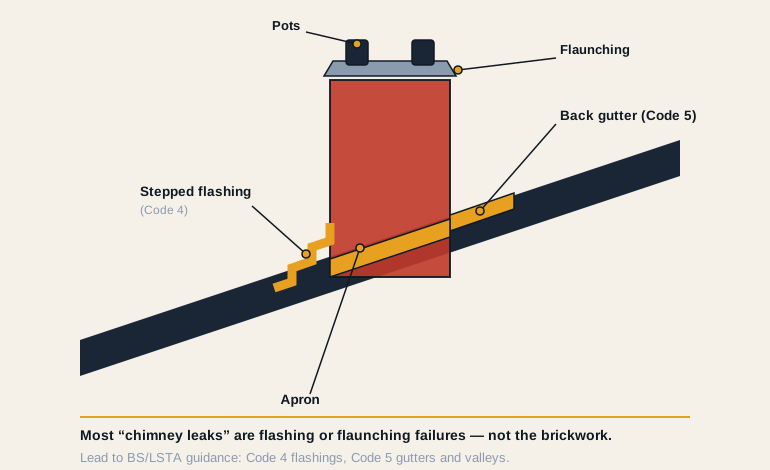
We use Code 4 lead (1.8mm) for flashings and dressings, Code 5 (2.24mm) for valleys and flat sections. All work is laid with correct bossing, proper drips and adequate movement allowance for Wiltshire temperature ranges.
Free quotes · No call-out fee
Leadwork — valleys, flashings, soakers and lead-covered features — is where a huge share of roof leaks begin, because lead fatigues and lifts over time.
When it is not the answer: Old lead isn't always failed lead — if it's sound and just needs re-dressing or re-pointing in, that's cheaper than renewal. Read the full guide.
Leadwork is central to Salisbury's roofs because so much of the city's stock is the age where lead does the weatherproofing — the Victorian terraces off Fisherton and Milford with their party-wall stacks and secret valleys, the period and listed properties around the Cathedral Close, and the many bay and dormer details across the older housing. Old lead fatigues, lifts and splits, and on these buildings a sealant smear is never the answer: it has to be re-formed and dressed in the correct code, usually Code 4 or 5, with proper laps and pointing. On conservation and listed roofs that's also what the rules require, and it's what keeps a period Salisbury roof watertight for decades rather than seasons.
We locate the failed lead and check the detailing around it.
Itemised quote specifying the lead code (usually Code 4 or 5) and the work.
Leadwork needs safe standing time, so we arrange access first.
We form and dress new lead to the correct code, with proper laps, clips and pointing — no short-cut sealant fixes.
Area left weathertight, guarantee handed over.
| Job | Typical duration |
|---|---|
| Renew a flashing | Half a day – 1 day |
| Rebuild a lead valley | 1–2 days |
| Re-lead a dormer or bay | 2–3 days |
| Chimney soakers & flashings | 1 day |
Lead dresses best in dry, mild conditions; we avoid hard frost.
Leadwork on valleys and stacks needs scaffold or a secure working platform. Scaffold is specified for: valley rebuilds, chimney flashings and any dormer or bay leadwork - always itemised in your written quote, never a hidden extra, and we arrange it.
Salisbury's dense Victorian terraces off Fisherton and Milford mean rear-access scaffold and permit-controlled pavement space, while the post-war Bemerton Heath and Bishopdown estates give easier access but ageing concrete-tile roofs. Pavement scaffold and skip permits go through Wiltshire Council; allow a few working days on streets like Fisherton Street, Milford Street where space is tight.
| Job | Typical range | Notes |
|---|---|---|
| Renew a flashing | £200–£500 | Code 4/5 lead |
| Rebuild a lead valley | £500–£1,200 | Per valley |
| Re-lead a dormer/bay | £700–£1,800 | Detailed leadwork |
| Chimney soakers & flashings | £350–£750 | Around the stack |
| Lead per metre (valley) | £60–£120 | Code 5 |
Worked example: A rebuilt Code 5 lead valley on a period property in Salisbury: around £780 including access.
No deposit on repairs under £500; staged payments on larger jobs with nothing up front before materials are on site. Repairs are standard-rated; a full re-roof usually attracts 5% VAT.
Covering SP1, SP2 and surrounding postcodes.
Correctly-coded, properly-dressed lead is guaranteed for up to 10 years and typically lasts far longer.
If a fault appears in covered work, we come back and put it right. No quibbling, no re-charge.
External work over a day or two with scaffold in place; quiet and low-mess. You do not need to stay home for external work - we just need power and access agreed in advance.
We schedule leadwork around dry windows so joints dress and point cleanly. Salisbury sits where five rivers meet, so valley-floor humidity accelerates moss and slows drying, while higher ground catches wind-driven rain.
"Bay window lead roof had been leaking for two years. Three layers of sealant from a previous firm had made it worse. These lads stripped it back to the boards, new Code 5 lead dressed correctly with proper drips. Dry immediately, looks perfect."
"Lead valley on the Victorian terrace replaced — it had failed at the soakers. Very neat work, they understood exactly what the job needed. No problems since."
"Church roof lead repair in the Downton area. Professional approach, quality materials, treated the building with respect. Good experienced team."
Lead valley replacement costs £500-£1,200. Lead flashing re-runs at chimney stacks from £350-£900. Bay window lead roof replacement from £800-£2,500 depending on size and complexity. We quote all lead work individually after a site visit.
High-quality lead roofing work lasts 50-100 years. A lead valley or flashing installed correctly with proper drips and expansion allowances will likely outlast the property. The failures we see in Salisbury are almost always due to poor original installation, not lead failure itself.
We use Code 4 lead for flashings and dressings, Code 5 for valleys and bay roofs. For conservation area and listed building work in Salisbury, we comply with LODA (Lead Contractors Association) guidance and can provide certification of materials and workmanship.
Victorian properties in Fisherton and St Paul's were designed around lead — valleys, chimney flashings, bay roofs and parapet gutters all use lead as the primary weatherproofing material. Substituting cheap alternatives in these positions causes accelerated failure. Lead is the correct material and the only one that will last in these applications.
Code 4 lead (1.8mm) is the minimum for flashings and soakers. Code 5 (2.24mm) is correct for valleys, parapet gutters and any exposed horizontal surfaces. Code 6 (2.65mm) is specified for flat roof sections and large parapet areas. Using undersized lead code is one of the most common causes of premature lead failure — we always specify the correct code for each application regardless of whether a lighter code might appear adequate in the short term.
Correctly installed lead using the right code will last 60-100 years. Lead failures in Salisbury are almost always the result of: incorrect code used originally; incorrect fixing that restricts thermal movement causing fatigue cracking; or poor detailing at upstands and drips. Original Victorian and Edwardian lead on Salisbury's Cathedral Close and period properties is frequently still serviceable at 100+ years when it was correctly installed. We always investigate whether existing lead can be reformed rather than replaced.
Yes. We work regularly on listed buildings in Salisbury including Cathedral Close properties. Lead replacement on a listed building may require listed building consent depending on the scope — we advise on this and can liaise with Wiltshire Council's conservation officer. All lead work on historic buildings is carried out using correct code lead, traditional bossing and dressing techniques, and lime mortar at all masonry junctions. We do not use lead substitutes on historic properties.
No call-out fees. No obligation. Just an honest quote from a local Salisbury roofer who turns up when they say they will.
0172 223 9611