A clear, honest 2026 breakdown of what a new roof actually costs in Salisbury — by material, house type and the local factors that move the price. No sales pressure, just real figures.
Tell us the job in 30 seconds. No pushy sales, no call-out fee.
📞 Call Now: 0172 223 9611A new roof in Salisbury costs £6,500–£11,500 for a typical 3-bed semi in concrete tile, £9,500–£15,500 in clay tile, and £11,000–£18,500 in natural slate. All figures include scaffolding, strip-off, new membrane, battens and disposal. Free survey and fixed quote: 0172 223 9611.
A full re-roof means stripping the old covering back to the rafters, fitting new breathable underlay and treated battens, then laying your new tiles or slates with fresh ridge, verge and lead detailing. A proper quote covers scaffolding, strip-off and disposal, all materials, and the guarantee — not just the tiles on top.
The single biggest lever on price is the covering material. Concrete interlocking tile is the most economical mainstream choice; clay plain and peg tile costs more but lasts far longer and is often required on Salisbury's older and conservation-area properties; natural Welsh slate sits at the top for both price and lifespan. Roof size and pitch, the number of hips, valleys and chimneys, and whether the timbers underneath are sound all move the final figure.
Re-roofing an existing home usually qualifies for the reduced 5% VAT rate rather than 20% — always get that confirmed in writing. Where more than a set proportion of the covering is replaced, Building Control involvement is normally required, and we handle that Building Control notification as part of the job, so nothing is left for you to arrange or worry about after the scaffold comes down.
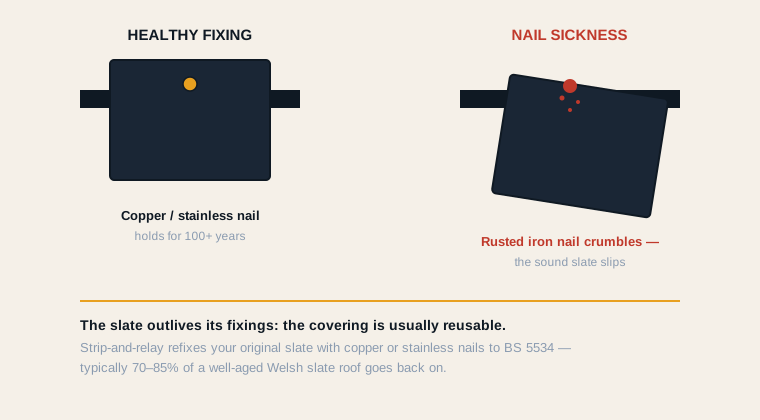
Salisbury's roofs fall into distinct cost brackets depending on where you are. The large post-war concrete-tile estates — Bemerton Heath, the Friary and lower Bishopdown — are now reaching the age where nail sickness affects whole roofs at once, and these are typically the most affordable re-roofs because concrete interlocking tile is quick to strip and relay on a simple gable roof. A straightforward semi on one of these estates usually sits at the lower end of the concrete band.
The Victorian terraces off Fisherton Street, around Milford and along Castle Road are a different proposition. Many carry clay plain tile or Welsh slate, both of which need careful matching, and the cut roofs with their valleys and back-additions take longer to strip and detail. Access on the tighter terraced streets can mean a scaffold licence from Wiltshire Council, which we arrange. Expect these to price in the clay or slate bands rather than the concrete one.
In the Cathedral Close, the city-centre conservation area and Harnham, the material choice is often not yours to make freely — conservation and listed-building requirements mean like-for-like clay tile, natural slate or stone, sourced to match, which carries a premium of roughly 20–40% over a standard estate re-roof. We price these per specification following survey rather than off a rate card, because no two period roofs in central Salisbury are the same.
As a worked example: a three-bed semi on the Bishopdown estate with a simple gable roof of around 80 square metres, re-covered in concrete interlocking tile with new membrane, battens, ridge and scaffolding, typically lands around £7,500–£9,000. The same footprint in Harnham finished in clay plain tile to match a conservation-area streetscape can reach £12,000–£14,000 once matching materials and slower detailing are accounted for.
Modern estates change the picture again. The newer developments at Old Sarum, Longhedge, Hampton Park and Fugglestone Red were built with concrete interlocking tile and simple, efficient roof shapes, so when these roofs eventually need re-covering they sit firmly at the economical end. Many are still within their original build-warranty period, so what we more often see here is post-warranty defect work — loose dry-ridge clips, failed Velux flashings — rather than full re-roofs.
Typical supplied-and-fitted prices for a standard 3-bed semi, including scaffolding, strip-off, new membrane, battens and disposal:
Salisbury sits on the southern-England baseline for labour, below London and the South East premium. Prices are indicative and confirmed by fixed written quote after a free survey. Re-roofing usually attracts 5% VAT, not 20% — confirmed in writing.
Manufacturer data indicates natural slate has a service life exceeding 100 years, while concrete interlocking tile is typically warranted for 30 years and reaches 40–60 years in service — the reason material choice, not headline price, decides long-term value.
— Manufacturer technical data / NFRC
Want a fixed, itemised price for your specific Salisbury roof? Book a free survey today.
📞 Call 0172 223 9611A full or partial re-roof is a big spend, so it's worth knowing the signs that a roof has genuinely reached the end — rather than one that just needs a repair.
When it is not the answer: If the covering is sound and only the lead, flashings or a single valley have failed, a full strip is an oversell — renewing those is a fraction of the cost. Read the full guide.
We assess every slope, the timbers and the loft, measure up, and confirm whether a full or partial re-roof is right.
A detailed itemised quote: materials, scaffold, disposal, VAT rate and a realistic timescale.
We book around the weather and arrange the scaffold licence where the street needs one.
We strip the old covering, renew battens and breathable underlay, re-lay tiles or slates, and renew lead and ridges.
Full site clear, roof left watertight, and a written 10-year guarantee handed over.
| Job | Typical duration |
|---|---|
| Small terrace / single slope | 2–4 days |
| 3-bed semi re-roof | 5–8 days |
| Large detached / complex roof | 1–2 weeks |
| Partial re-roof (one slope) | 2–3 days |
Re-roofs are weather-dependent; we never leave a roof open overnight and reschedule tiling in high wind.
A re-roof always needs full scaffold for safe working and to protect the property below. Scaffold is specified for: the whole job — a re-roof is not a ladder job - always itemised in your written quote, never a hidden extra, and we arrange it.
Salisbury's dense Victorian terraces off Fisherton and Milford mean rear-access scaffold and permit-controlled pavement space, while the post-war Bemerton Heath and Bishopdown estates give easier access but ageing concrete-tile roofs. Pavement scaffold and skip permits go through Wiltshire Council; allow a few working days on streets like Fisherton Street, Milford Street where space is tight.
| Job | Typical range | Notes |
|---|---|---|
| Terrace / single slope re-roof | £3,500–£6,000 | Concrete tile, incl. scaffold |
| 3-bed semi full re-roof | £6,000–£9,500 | Tiles, underlay, battens, lead |
| Large detached re-roof | £9,500–£16,000 | Size/complexity dependent |
| Natural slate re-roof | £9,000–£20,000+ | Welsh/Spanish slate premium |
| Partial re-roof (one slope) | £2,500–£5,000 | Targeted value option |
Worked example: A full concrete-tile re-roof on a 1970s semi in Salisbury with a 10-year guarantee: around £8,000 including scaffold and waste.
No deposit on repairs under £500; staged payments on larger jobs with nothing up front before materials are on site. Repairs are standard-rated; a full re-roof usually attracts 5% VAT.
Covering SP1, SP2 and surrounding postcodes.
The re-roof carries a written 10-year workmanship guarantee, transferable if you sell, plus manufacturer warranties on the tiles or slates.
If a fault appears in covered work, we come back and put it right. No quibbling, no re-charge.
Scaffold up for the duration, skip on site, and a week or so of activity — we protect the drive and garden and keep the site tidy daily. You do not need to stay home for external work - we just need power and access agreed in advance.
We work through most of the year but plan re-roofs around dry windows and keep the roof weathertight at every stage. Salisbury sits where five rivers meet, so valley-floor humidity accelerates moss and slows drying, while higher ground catches wind-driven rain.
"They re-roofed our 1960s semi on Bemerton Heath in concrete tile after years of slipping tiles. Fixed price up front, scaffold up and down within the fortnight, and the price included everything — no surprise extras."
"Our Harnham cottage needed clay tile to match the conservation area. They handled the whole specification and the council side, and matched the existing roof beautifully. Not the cheapest quote but by far the most thorough."
"Honest from the first visit — they told us half the roof was sound and we only needed the rear slope done, saving us thousands over the full re-roof another firm quoted. That's why we trust them."
The most expensive mistake a Salisbury homeowner can make is repeatedly repairing a roof that has reached the end of its life. On the post-war concrete-tile estates especially, once nail sickness takes hold across a slope, each winter brings another handful of slipped tiles — and each call-out, scaffold hire and repair adds up until you have spent a large fraction of a re-roof without solving anything. The sensible rule of thumb is that when repair costs approach 40% of replacement cost on a roof already over 30 years old, replacement is the better long-term value.
Age and material matter too. A concrete-tile roof on a 1965 estate house is at 60 years, past its expected span, so investing heavily in repairs rarely pays. A Welsh slate roof on a Victorian terrace off Fisherton Street, by contrast, can be sound at 100 years if the slates themselves are good and only the fixings or flashings have failed — there, targeted repair or a partial re-lay is usually the right spend, not a full strip. We assess remaining life honestly at survey and tell you which category your roof falls into.
There are legitimate ways to manage the cost of a new roof without cutting corners. Doing the guttering and fascias at the same time saves a second scaffold hire. Timing the work outside the autumn and winter peak can help availability. And insisting on an itemised quote — separating materials, scaffolding, labour and disposal — lets you compare like with like and spot where a cheap quote has quietly left something out, such as Building Control notification or proper underlay. What we never recommend is saving money by skipping the membrane, reusing tired battens, or bedding ridges in sand-and-cement rather than a flexible mortar; those shortcuts simply bring the next problem forward.
Finally, watch for the reduced VAT position. Re-roofing an existing home usually qualifies for 5% VAT rather than 20%, a meaningful saving on a five-figure job, and we confirm the applicable rate in writing before work begins. Combined with an honest assessment of whether you truly need a full re-roof or just a repair, that transparency is how we make sure Salisbury homeowners spend once and spend right.
For a typical 3-bed semi in Salisbury, expect £6,500–£11,500 in concrete tile, £9,500–£15,500 in clay tile, and £11,000–£18,500 in natural slate. All-in prices include scaffolding, strip-off, new membrane, battens and disposal.
Conservation-area and listed-building rules require matching traditional materials such as clay plain tile or natural slate, sourced to match the existing roof. This adds roughly 20–40% over a standard estate re-roof, plus slower, more careful detailing.
Like-for-like re-roofing usually does not need planning permission, but listed buildings and material changes in conservation areas do. Most full re-roofs need Building Control notification, which we handle as part of the job.
Yes. Safe access is a legal requirement for work at height, so scaffolding is always a line in our written quote, never a hidden extra. For a 3-bed semi it typically runs £800–£1,800 for two to three weeks.
A standard 3-bed semi re-roof takes 3–5 working days in dry conditions. Cut roofs with multiple valleys, chimneys or conservation detailing take longer. We give a realistic timeline at survey.
Re-roofing an existing dwelling usually qualifies for the reduced 5% VAT rate rather than 20%. We confirm the applicable rate in writing before any work begins.
We flag likely timber work at survey wherever it's visible, and show you any concealed rot before replacing it. Timber repairs typically add £500–£2,000 depending on extent — agreed with you, never done unseen.
Yes. All our re-roofs carry a written 10-year workmanship guarantee, alongside the manufacturer's product warranty on the tiles or slates, which can run to 30 years or more.
Free survey, honest advice on repair versus replacement, and a written itemised quote with no call-out fee. Covering Salisbury and all surrounding areas.
0172 223 9611 📞 Call Now — Free Quote