Chimney repointing, flaunching, cowls and capping across Salisbury — using lime mortar on period stacks and correct methods throughout. We stop the water ingress a failing stack lets in.
Tell us the job in 30 seconds. No pushy sales, no call-out fee.
📞 Call Now: 0172 223 9611Chimney repointing in Salisbury costs from £150 to £800+ per stack depending on scope, covering repointing, flaunching, cowls and capping. Pre-1920 stacks need lime mortar, not cement. A failing chimney is a common hidden cause of upstairs damp. Free survey: 0172 223 9611.
A chimney takes more weather than any other part of the roof, exposed on every side and often at the highest, windiest point of the building. Repointing renews the mortar joints between the bricks or stone as they weather and recede; flaunching renews the mortar bed that holds the pots and sheds water off the top of the stack; and cowls or caps close off redundant or open flues to keep rain and birds out. Each addresses a different route by which water gets into a stack.
The choice of mortar matters enormously. On any pre-1920 stack — and Salisbury has a great many — the correct material is lime mortar, not modern Portland cement. Cement is too hard and impervious for soft historic brick and stone: it traps moisture, forces it into the masonry, and causes the brick faces to spall and crumble. Using lime on period stacks isn't a nicety, it's the difference between a repair that lasts and one that accelerates the decay.
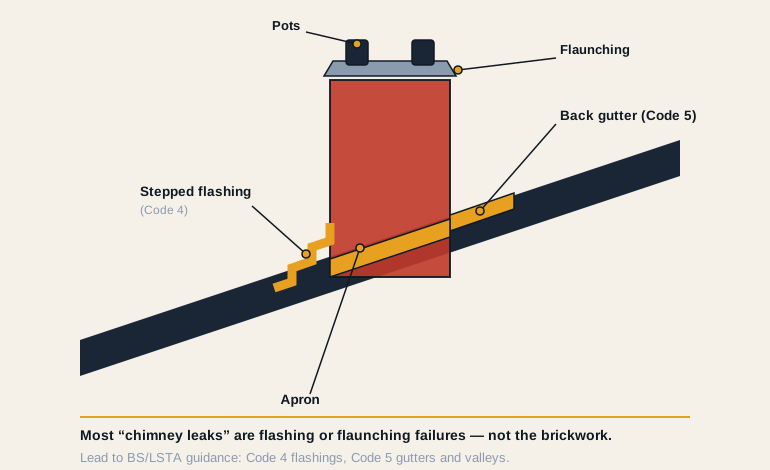
A leak blamed on the roof is very often a chimney problem. The pointing, flaunching and the lead apron and soakers around the base all fail with age, and water tracking in at the stack shows up as a damp patch on a bedroom ceiling that looks like a roof leak. When we investigate upstairs damp on a period Salisbury property, the stack is one of the first things we check.
Salisbury's skyline is full of original chimney stacks, and they fail in patterns set by age and exposure. The city-centre and Cathedral Close properties, along with the Victorian terraces off Fisherton Street and around Milford, carry soft-brick and stone stacks built in lime mortar. Decades of Salisbury weather have eroded the joints and cracked the flaunching, and because these are among the tallest, most exposed elements on the roof, they take the brunt of the prevailing south-westerly wind and rain.
Exposure varies sharply with location. Stacks on the Bishopdown ridge and the properties on higher ground catch far more weather than those sheltered in the valley, and it shows in faster mortar loss on the prevailing face. On the estate housing, the stacks are younger and usually cement-pointed, so the issue there is more often cracked flaunching, loose pots and failed lead aprons than wholesale repointing — a different and usually cheaper job.
The material question is sharpest in the conservation areas and on the listed stock. In the Close, the city-centre conservation area and Harnham, repointing a period stack in the wrong mortar isn't just poor practice — it can breach conservation requirements and damage a historic building. We repoint these in matched lime mortar to the correct specification, and where a stack is on a listed property we advise on any consent needed before work begins.
Itemised by scope, per stack:
Access usually needs scaffold or a tower, itemised separately. Pre-1920 stacks are repointed in lime mortar as standard. Free survey and written price, no call-out fee.
Historic England guidance specifies that pre-1919 masonry should be repointed in lime mortar, not Portland cement, which traps moisture and causes accelerated spalling of soft historic brick.
— Historic England pointing guidance
Damp patch upstairs or a weathered stack? Book a free chimney survey today.
📞 Call 0172 223 9611Repointing renews the mortar joints in a chimney stack — once they've weathered out, wind-driven rain gets into the brickwork and down into the house.
When it is not the answer: If only the flaunching around the pots has gone, that's a smaller job than a full re-point — we'll tell you which the stack actually needs. Read the full guide.
We assess the joints, the brick type and the right mortar mix — lime for older stacks, not hard cement.
Itemised quote for raking out and re-pointing, with flaunching if needed.
Stack access is arranged before the day.
We rake out the failed joints and re-point in a matched, breathable mortar, renewing flaunching around the pots.
Stack left sound, debris cleared, guarantee handed over.
| Job | Typical duration |
|---|---|
| Flaunching renewal | Half a day |
| Re-point one face | 1 day |
| Full stack re-point | 1–2 days |
| Re-point + flashing renewal | 2–3 days |
Mortar needs dry, frost-free conditions to cure properly.
Repointing needs scaffold for safe standing time at the stack. Scaffold is specified for: all stack repointing — it's never a ladder job - always itemised in your written quote, never a hidden extra, and we arrange it.
Salisbury's dense Victorian terraces off Fisherton and Milford mean rear-access scaffold and permit-controlled pavement space, while the post-war Bemerton Heath and Bishopdown estates give easier access but ageing concrete-tile roofs. Pavement scaffold and skip permits go through Wiltshire Council; allow a few working days on streets like Fisherton Street, Milford Street where space is tight.
| Job | Typical range | Notes |
|---|---|---|
| Flaunching renewal | £150–£350 | Around the pots |
| Re-point one face | £300–£600 | Matched mortar |
| Full stack re-point | £500–£1,100 | All faces |
| Re-point + flashing | £700–£1,500 | Combined |
| Lime re-point (period) | £600–£1,300 | Breathable mortar |
Worked example: A full lime re-point of a period stack in Salisbury: around £780 including scaffold.
No deposit on repairs under £500; staged payments on larger jobs with nothing up front before materials are on site. Repairs are standard-rated; a full re-roof usually attracts 5% VAT.
Covering SP1, SP2 and surrounding postcodes.
Correctly-mixed, properly-cured re-pointing is guaranteed for up to 10 years.
If a fault appears in covered work, we come back and put it right. No quibbling, no re-charge.
Scaffold to the stack for a day or two; external, with brick dust and old mortar we clear as we go. You do not need to stay home for external work - we just need power and access agreed in advance.
We schedule around dry spells so the new mortar cures rather than washes out. Salisbury sits where five rivers meet, so valley-floor humidity accelerates moss and slows drying, while higher ground catches wind-driven rain.
"Repointed and re-flaunched the old stack on our Close-area house in lime mortar, exactly as it should be. They understood the conservation side completely. Faultless."
"The 'roof leak' in our Milford terrace turned out to be the chimney all along. New flaunching and lead apron and the damp patch dried out. Proper diagnosis."
"Loose pot and cracked flaunching on our Bishopdown semi — sorted quickly and safely, fair price. Capped an unused flue too so no more birds."
Repointing is the headline job, but a chimney is a small system with several parts that age together. The pots themselves crack and loosen; the flaunching that beds them erodes; the lead apron, soakers and back gutter where the stack meets the roof fatigue and split; and redundant flues left open let rain and birds in. A stack that needs repointing usually needs one or two of these attended to at the same time, which is why we survey the whole chimney rather than quoting the pointing in isolation.
Ventilation is an easy detail to get wrong when capping a disused flue. A sealed flue with no airflow can trap moisture and cause damp inside the breast, so we fit capping cowls that close the flue to weather while still allowing it to breathe. On Salisbury's older properties, where breasts and flues are often built in soft, absorbent brick, that small provision prevents a damp problem appearing months later.
Because the chimney is the most exposed part of the roof, it is also the best early-warning indicator of wider weathering. When we are up at the stack we take the opportunity to check the surrounding ridge, the top courses of the roof and the nearest tiles, so anything starting to fail near the most weather-beaten point of the roof gets flagged before it becomes the next leak.
Chimney repointing runs from £150 to £800+ per stack depending on scope. Flaunching renewal is £150–£400, cowls £80–£200, and lead apron renewal £350–£1,000. Access is itemised separately.
Pre-1920 stacks are built in soft brick or stone that needs a breathable lime mortar. Modern cement is too hard and impervious — it traps moisture and causes the masonry to spall and crumble. Lime is the correct, lasting repair.
Very possibly. Failed pointing, flaunching or the lead apron around the stack lets water track in, showing as a bedroom ceiling stain that looks like a roof leak. We always check the stack when investigating upstairs damp.
Flaunching is the mortar bed on top of the stack that holds the pots and sheds water. Exposed to the full weather, it cracks and erodes over time, letting water into the stack and loosening the pots — a common and important repair.
Yes, in matched lime mortar to the correct specification. Using the wrong mortar on a period or listed stack can breach conservation requirements and damage the building. We advise on any consent needed for listed properties.
Yes. We fit cowls or caps to close redundant or open flues, keeping out rain and birds while maintaining any ventilation the flue needs. It's a common, cost-effective job.
Usually a scaffold or tower is required for safe access to the stack, which we itemise separately. The height and position of the chimney determine what's needed.
Signs include receding or missing mortar joints, cracked flaunching, leaning or loose pots, staining on the stack, and damp appearing in the room below. A free survey confirms what's needed.
Repointing, flaunching, cowls and capping — lime mortar on period stacks, correct methods throughout. Free survey, no call-out fee, across Salisbury and surrounding areas.
0172 223 9611 📞 Call Now — Free Quote